2025 – Another Near-Record Hot Year Sends a Clear Climate Warning to the World

Earth has once again recorded one of its hottest years. Climate scientists say the trend is no longer gradual. It is accelerating.
Global temperature data from multiple climate monitoring agencies show that 2025 ranked among the three hottest years ever measured. The difference between 2023 2024 and 2025 is very small. World Meteorological Organization, NASA, and NOAA officials said the temperatures in 2023 and 2025 were almost identical, differing by just 0.04°F.
Scientists do agree the difference is very small. In simple terms, these years are almost equal in heat but record-breaking nonetheless.
The planet’s average temperature in 2025 was about 59.1°F. This is roughly 2.6°F higher than temperatures before the industrial era according to the data by the World Meteorological Organization. Most temperature records used in these calculations date back to 1850 that aligns with the start of the industrial era in human history.
The last three years have pushed dangerously close to the global warming limit set under the 2015 Paris Agreement. That limit aims to keep warming below 2.7°F. Climate experts now warn this threshold is likely to be crossed within the next decade.
“Human activities are causing world temperatures to rise, posing serious threats to people and nature,” Mark Poynting, the BBC’s Climate reporter writes. “Things are likely to worsen in the coming decades, but scientists argue urgent action can still limit the worst effects of climate change.”
Climate Change is defined as “the long-term shift in the Earth’s average temperatures and weather conditions.”
Rising temperatures increase the intensity of extreme weather. Heat waves are becoming longer and more frequent. Storms are growing stronger. Floods droughts and wildfires are causing greater damage to lives and economies.
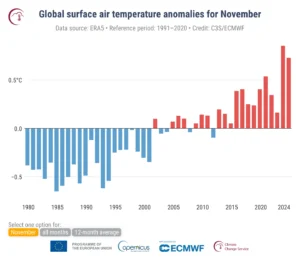
The year 2024 was the hottest ever recorded on Earth, driven mainly by climate change. It also became the first year to exceed 1.5°C of warming above pre-industrial levels, according to the European Copernicus climate service.
The climate service reported in December 2025, “2025 will finish as the second- or third-warmest year on record after 2024, potentially tied with 2023, currently the second-warmest year. It also sets the global three-year average temperature for 2023–2025 on track to exceed 1.5°C above pre-industrial levels for the first time in the instrumental period, according to the ERA5 dataset.”
The past 11 years are now the 11 hottest years ever recorded. Scientists say nearly all of this warming is caused by human activity. The burning of coal oil and gas or fossil fuels in the common term remains the primary driver of the rising global mean temperature.
Short-term factors also influenced recent temperatures. These include reduced air pollution around the world, changes in solar activity and the lingering effects of a past underwater volcanic eruption.
Even so experts agree these factors are minor compared to greenhouse gas emissions.
In last three years, heat records were broken across large parts of the world. Millions of people experienced extreme heat for the first time. China Australia northern Africa the Arabian Peninsula and Antarctica were among the hardest hit regions.
The United States recorded its fourth warmest year.
Extreme heat also poses serious health risks. It increases cases of heat exhaustion and heatstroke.
Warmer air holds more moisture which leads to heavier rainfall and more intense storms.
Natural climate cycles such as El Niño and La Niña usually influence global temperatures. Last year weak cooling conditions slightly reduced warming. Despite this global temperatures remained near record highs. Scientists expect warming to intensify again when the next El Niño develops and is expected to make a comeback in 2026.