iPhone 17 Carbon Footprint: Interesting Facts

You know that moment when you unbox the newest iPhone from the famous luxury brand Apple, but do you ever ask yourself, “Did I really need this upgrade?” I bet you don’t. Maybe you did need the upgrade, even if it’s only incremental compared to last year’s models.
With Apple just dropping the iPhone 17 lineup (on 9th of September, like a few days back), that’s a fair question to ask about the overall carbon footprint of the newly released models on the Earth.
Apple proudly claims that the iPhone 17 series, along with Apple Watch series and Apple AirPods, is doing more than just upgrading the components and polishing.
The brand’s claims about pushing hard on recycled materials, renewable energy, and smarter packaging look good on paper.
It has detailed its environmental efforts along with other highlighted features. So, let’s see what they are claiming with the official data shared publicly, even though there’s little interest in how sustainable the brand’s approach really is.
Most people are focused on getting their hands on the new models rather than caring about the “boring” details of emissions and the environment. Honestly, I shouldn’t care either, but I was curious to see what their approach is toward the environment, especially since this concerns me a little, given my background in climate change and environmental science studies.
iPhone 17 Carbon Footprint
Apple claims that iPhone 17 uses 30% recycled materials by weight, 35% of its manufacturing electricity comes from supplier renewable projects, and redesigned packaging allows 35% more devices to be shipped per trip.
Apple says the iPhone 17 (256GB) has a carbon footprint of 55 kg CO2e, with emissions coming mainly from electricity for production (53%), materials and process production emissions (23%), electricity for Charging (18%).
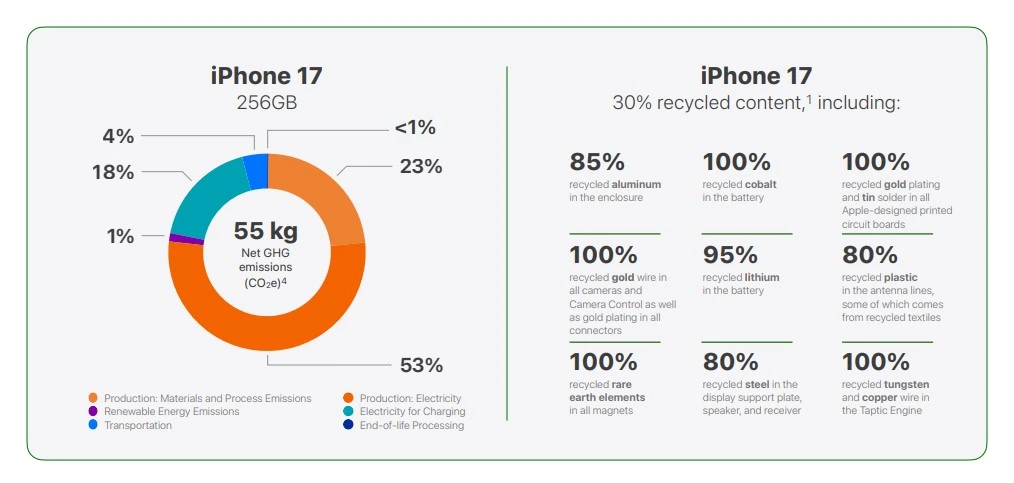
Apple says it calculates iPhone carbon emissions using ISO-standard life cycle assessments, covering the product, packaging, and accessories.
Results vary by model configuration: the 256GB iPhone 17 has a footprint of 55 kg CO2e, while the 512GB version is 61 kg CO2e. Apple uses detailed data for major components and industry averages for others.
61 kg of carbon dioxide equivalent is roughly equal to consuming 26 litres of gasoline or 155
miles driven by an average gasoline-powered passenger vehicle, according to estimates from the Greenhouse Gas Equivalencies Calculator. You can do the calculation yourself with the greenhouse gas equivalencies calculator provided online to better understand the metrics here.
Apple states that iPhone 17 is made with 30% recycled content.
Apple’s iPhone 17, according to the company, uses packaging that is 100% fiber-based and ships 35% more units per trip (perks of shipping no charger in the box?). Final assembly sites send zero waste to landfill.
According to the data by Apple, “3.6M metric tons of supplier facility waste diverted from landfills through our Zero Waste Program.”
Ceramic Shield 2 improves durability by 3 times compared to last year’s base model. More components are now repairable, as per Apple.
For the higher variants of the 17 lineup, as per the brand; about 40% of the electricity used in manufacturing iPhone 17 Pro/Pro Max comes from renewable sources. Statistically speaking, 24% of materials shipped in Apple products in 2024 came from recycled or renewable sources.
Why should any of this matter to you?
When more recycled materials are used, there’s less mining, less waste, and often less energy needed. Renewable power in factories cuts down on fossil fuel dependence. And efficient packaging/travel means fewer emissions in getting stuff shipped around.
The iPhone 17 upgrades the display to 6.3 inches with a 120Hz ProMotion screen, while the iPhone 16 base model had 60Hz. The chip is now the new A19, replacing the iPhone 16’s A18. Camera improvements include a 48MP dual fusion rear system and an 18MP front “Center Stage” camera with a better sensor and wider field of view. Apple also raised base storage — the iPhone 17 starts at 256GB instead of 128GB of storage in previous year of iPhone 16 base model.
These changes aren’t radical, but each adds up I guess.
The iPhone 17 brings only incremental changes in real-world use sense, like faster charging, stronger build, small design tweaks, and color changes.
There are genuine concerns that can be raised for good reason. That’s even if I don’t usually align myself with every critique. It’s a broader reflection of how the tech industry functions, which is always looking to balance innovation, profit, and the sustainability trinity.
In the end, the buyers and users, are the real decision-makers.
Where Does Apple Stand When It Comes to Caring for the Planet?
According to World Business Council for Sustainable Development,
“There are now 17.8 gigawatts of renewable electricity online in Apple’s global supply chain, which helped avoid 21.8 million metric tons of greenhouse gas emissions in 2024.”
Apple says it is “focused on decarbonizing the three largest sources of emissions—materials, electricity, and transportation—across our value chain.”
For the iPhone 17, the company points to progress in sourcing cleaner power, noting that “35 percent of manufacturing electricity was sourced from renewable energy projects.”
Apple also highlights a growing reliance on “recycled, renewable, and low-carbon materials,” adding that it works to recover its own scrap at high purity and tap post-consumer waste streams. The recycled material typically emits less carbon and need less energy than newly mined materials over its lifetime.
Apple says it has “reduced our emissions by over 60%”. This milestone, the company argues, brings it closer to its Apple 2030 goal of becoming carbon neutral across its global footprint. Apple has “committed to reducing our emissions by 75% compared with our 2015 baseline”. The remaining 25% to be offset through “high-quality carbon removal projects that protect and restore natural ecosystems.”
Quite an ambitious but realistic goal considering the might of the company. As of September 2025, Apple has a market capitalization of $3.473 trillion USD, making it the world’s third most valuable company by market cap.
“We’re incredibly proud of the progress we’re making toward Apple 2030, which touches every part of our business. Today, we’re using more clean energy and recycled materials to make our products than ever before, we’re preserving water and preventing waste around the world, and we’re investing big in nature.”
– Lisa Jackson, Apple’s vice president of Environment, Policy, and Social Initiatives on Apple 2030 target.